

"Doomed to Failure”
Veteran officials know the plan is unworkable. Political leadership doesn't care. And the budget has soared past $55 billion.
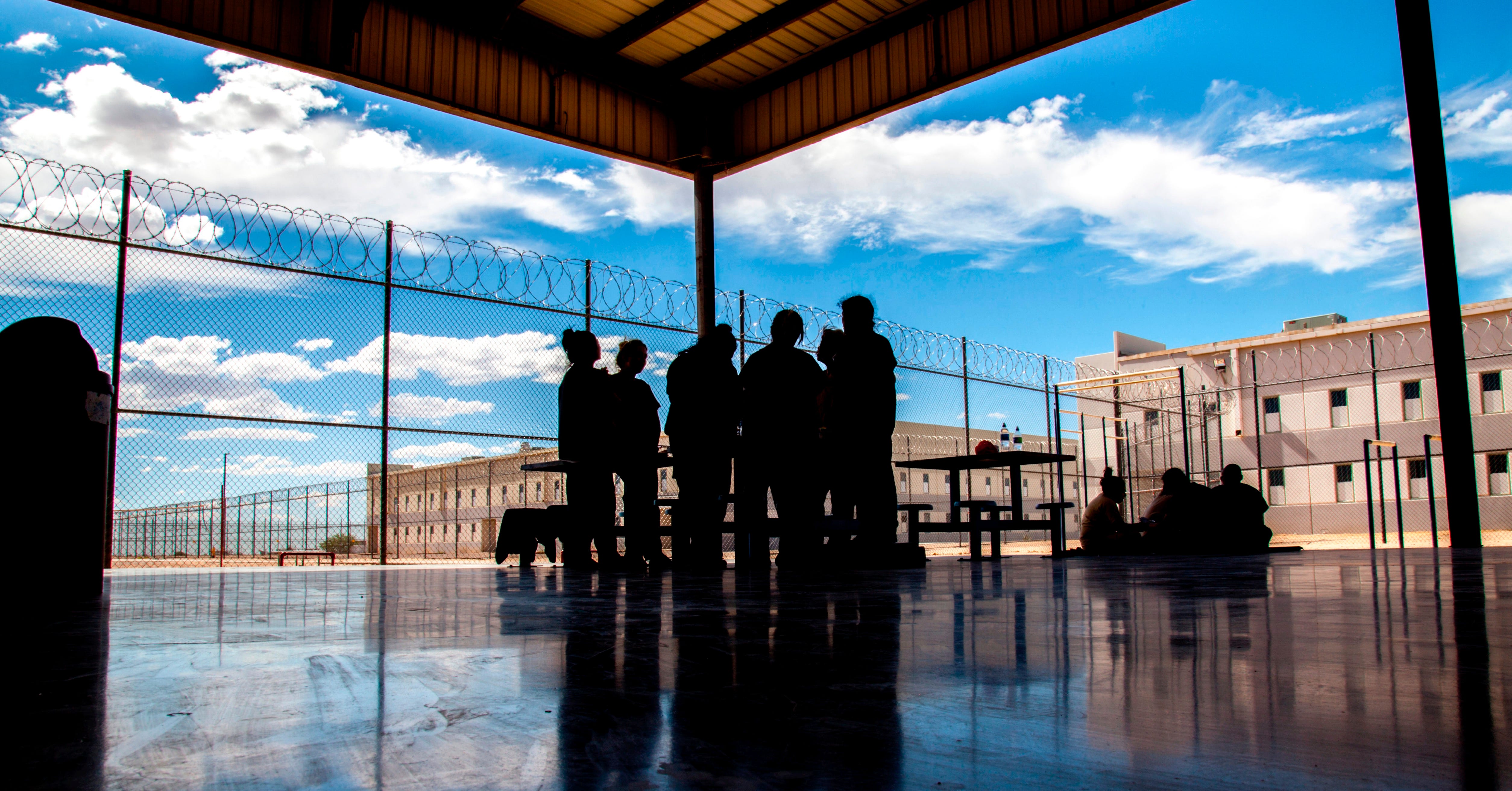
A federal procurement specialist with 25 years of experience in national security logistics has told Project Salt Box that career officials inside Immigration and Customs Enforcement (ICE) believe the Trump administration’s detention expansion is “doomed to failure.” The source, who is intimately involved in the current bidding process, spoke on the condition of anonymity to avoid professional retaliation in a highly politicized environment.
The account describes an operation driven by ideological mandates rather than operational feasibility. According to the source, warnings from experienced civil servants are being systematically overruled by political leadership that allegedly views “cruelty as the policy.”
The source’s firm, which has historically managed infrastructure for major federal agencies including Homeland Security and Health and Human Services, is currently reviewing requirements for a massive wave of new “turnkey” detention sites.
A Billion-Dollar Blueprint for Failure
The department’s current expansion of detention space is modeled after Camp East Montana at Fort Bliss, the military installation near El Paso, Tx., that has been repurposed for detention operations, according to the contractor.
The facility has been plagued with problems — assaults, harassment, poor living conditions and deaths, the contractor said. The $1.2 billion tent camp racked up 60 violations of federal detention standards within its first 50 days of operation, according to a leaked internal ICE inspection obtained by The Washington Post. Three people have died at the facility in less than two months.
In December, human rights groups including the ACLU, Human Rights Watch and the Texas Civil Rights Project sent a letter to ICE detailing accounts of beatings, sexual abuse, medical neglect and coerced deportations based on interviews with 45 detained people.
Two contractors have been removed and a third is struggling to manage operations, according to the contractor. The Fort Bliss contract was transferred to WEXMAC and awarded to Acquisitions Logistics Services, which has become the top spender on the contract vehicle with over $1.2 billion obligated.
The problems have crystallized concerns among career officials about repurposing military facilities. “ERO hates it,” the contractor said, relaying a senior official’s assessment. “Repurposing these facilities is hard, using Defense contracts means that the customer has less control over operations on site, and access is difficult.”
The department’s deepening reliance on Defense Department contracting is driven less by operational efficiency than by a set of internal restrictions imposed by Secretary Kristi Noem, according to the contractor.
Noem’s Bottleneck, “$100,000 at a Time”
Ms. Noem has implemented two policies that have paralyzed the department’s normal contracting process, according to the contractor.
First, she has required personal approval for any contract above $100,000. According to the source, one senior ICE official described the approach to vendors as “spending $55 billion $100,000 at a time.”
The policy, first reported by Federal News Network in June 2025, dramatically lowered the review threshold from $20 million. Experts warned the move would create backlogs and ethical risks. Mark Borkowski, former chief acquisition officer at Customs and Border Protection, called the policy “absolutely nuts.”
Second, all contracts are now limited to two years. Ms. Noem has said that “after two years, there won’t be a DHS,” the contractor said, relaying what a senior ICE official told vendors.
Project Salt Box corroborated both restrictions. A separate former federal procurement official who spoke on background earlier this year described the approval bottleneck as having created chaos within procurement operations.
A review by Project Salt Box of approximately 300 contracts awarded by the department since Jan. 1 found that only three lasted longer than two years — a sharp break from standard government contracting practice. Some two-year contracts included six-month extensions to allow for re-competition.
The restrictions have forced Homeland Security agencies to turn to Defense Department contract vehicles that allow for rapid action — moving from requirement to awarded contract in weeks rather than months, the contractor said.
The Navy’s TITUS Initiative and $55 Billion for Rapid Expansion
That reliance has led to increased use of WEXMAC — the Worldwide Expeditionary Multi Award Contract — issued by the Naval Supply Systems Command in Mechanicsburg, Pa., according to the contractor.
The contract vehicle, typically used for rapid military deployments overseas, was quietly amended in July 2025 to add “a new geographic region” — the United States and outlying territories, CNN first reported in October. The modification, called “WEXMAC 2.1, Territorial Integrity of the United States,” now allows contractors to provide infrastructure domestically.
WEXMAC 2.1 currently has 154 contract holders, though only 87 have any spending obligations to date. The ceiling was recently raised from $10 billion to $55 billion, according to reporting by Migrant Insider. Approximately 80 companies are approved vendors, the contractor said.
The Navy is currently in source selection for WEXMAC 2.2, which will onboard additional contractors to the vehicle. Bids were due Jan. 30, with awards expected in the coming months.
Pablo Manríquez, author of Migrant Insider, described the arrangement as creating “a nationwide ‘ghost network’ of concentration camps” that can be materialized anywhere in the U.S. the moment a site is selected.
Non-Disclosure Agreements Kept the November Expansion Under Wraps
The administration began coordinating the expansion with private industry months before the plans were disclosed to the public, according to the source.
In November 2025, the government distributed a list of 25 sites slated for conversion into detention centers to all eligible bidders. According to the procurement specialist, the administration used non-disclosure agreements to safeguard the information, ensuring that the specific locations remained hidden from local officials and the press while the private sector began its vetting process.
The list functioned as a confidential blueprint for the current wave of acquisitions. While The Washington Post first reported on leaked documents identifying potential sites in December 2025, the specialist said that vendors had already been analyzing the logistics of those locations for weeks.
The $102.4 million purchase of the Hagerstown warehouse in January 2026—first reported by Project Salt Box —provided the first public verification of the November list’s accuracy.
When Politics Overrules Operations
The selection of a proposed facility in Newport, Ore., illustrates how the administration has ignored internal professional advice in favor of politically driven choices, according to the specialist.
The source said that a senior ERO official had initially recommended utilizing federal buildings in Portland for detention. These sites were favored by career staff because they fall under the Supremacy Clause, which allows the federal government to bypass local zoning restrictions. However, someone within the administration pushed for the Newport location instead, effectively overriding the agency’s operational preference.
The decision has triggered a significant political and logistical backlash. Governor Tina Kotek and the Newport City Council have moved to block the project, with the specialist noting that the “entire state, county, and city” have mobilized against it.
Beyond the political resistance, the specialist described the Newport plan as an “operational nightmare” with prohibitive economics. The site is projected to hold no more than 200 to 300 beds at a cost of $700 to $1,000 per person, per day—roughly double the cost of standard facilities. Despite these warnings, the Department of Homeland Security has not formally withdrawn the site from its consideration list.
Prioritizing Warehouses, Ignoring Infrastructure
The ICE official’s recommendation was to purchase federal property or former detention facilities with existing infrastructure, reasoning that federal property would fall under the Supremacy Clause and already have appropriate utilities, the contractor said.
Instead, “they went the wrong way and looked at warehouses — mostly due to connections in the administration who had such sites they wanted to sell,” the contractor said.
The Hagerstown facility illustrates the problem. As Project Salt Box previously reported, the warehouse was allocated only six Equivalent Dwelling Units for water — appropriate for a logistics operation, not 1,500 people.
“ERO staff continues to state this is not a viable option, but they are consistently overruled,” the contractor said.
One warehouse on the leaked list is in Chester, N.Y., owned by a subsidiary of Icahn Enterprises. Carl Icahn, who founded the company, served as a special adviser to President Trump during his first term. Another warehouse, in Surprise, Ariz., was purchased for $70 million, NBC News reported.
The Math That Doesn’t Add Up
The contractor’s experience in national security contracting includes establishing base camps and life support operations worldwide for populations ranging from 10 to 10,000 people.
For a properly equipped facility with full services and infrastructure, costs typically run upward of $500 per person per day, the contractor said. The Office of Refugee Resettlement within Health and Human Services paid $750 per person per day for children in Influx Care Facilities operated by contractors including Deployed Resources and DBA Enterprise.
The administration has pushed for bare-minimum temporary facilities: cots, fencing panels, portable power, water via above-ground tanks, one shower facility for 100 people instead of the norm of 20, one toilet for 25 instead of 10, according to the contractor.
Infrastructure requirements drive costs higher, the contractor said. Short-term facilities require generators, water trucks and sewage removal. Longer-term operations require digging wells, building power transmission stations and installing sewage infrastructure. Without local cooperation on water and sewage, costs quadruple, the contractor said.
Using a conservative estimate of $200 per person per day, a 1,500-bed facility like Hagerstown would cost $300,000 per day — $9 million per month or $110 million per year, according to the contractor. “That is one site, and that $200 per day per bed is good for an easy site — locals aren’t causing issues — and some of these sites will easily be double or more of that cost.”
In Hagerstown, local resistance has been mounting. Washington County Indivisible has organized protests, and a formal legal challenge alleges the government circumvented required historic preservation review.
The department “currently budgets only slightly less than that figure for detention beds in their current budget in existing centers, so new capacity is expected to cost substantially more, especially temp bed space,” the contractor said.
When Money Is No Object
The contractor’s company is deeply involved in the WEXMAC bidding process. Task orders are issued with short turnaround times. Bids must cover catering, waste removal, legal services, security, communications systems and transportation — full turnkey operations, the contractor said.
The WEXMAC contract vehicle ceiling was recently modified to $55 billion, the contractor said. By comparison, ICE’s entire annual budget in recent years has been approximately $9 billion.
“You can see that they don’t care about the cost,” the contractor said. “Sky is the limit.”
A System Designed to Fail
The contractor described a procurement system reshaped by political directives, where career officials who question the approach lack authority to alter it.
According to the account, the system relies on military contracting mechanisms designed for overseas operations, now applied domestically. Contracts are limited to two years, based on the secretary’s reported belief that the department will not exist beyond that timeframe. And warehouse purchases move forward despite career officials’ warnings about inadequate infrastructure, in what the contractor described as decisions driven by administration connections.
The contractor said these elements prioritize visible action over operational effectiveness, with costs and feasibility treated as secondary concerns.
As the Hagerstown facility advances despite local opposition and infrastructure challenges, and as other sites remain under consideration, the contractor’s assessment stands as a warning from inside the process: the people tasked with implementation know the system is designed to fail.
They are building it anyway.
I have been writing about a local fight against bringing hyperscale data centers to my county for several months. I have learned a lot about how local policy and governance conditions, especially around zoning and permitting, can obscure activity. Projects go undetected until permits exist and zoning ordnances have been manipulated. Special meetings are called. Permitting uses alternative language to obscure the nature of the development. Data center developers also use non-disclosure agreements to their advantage.
Opposition to hyperscale projects seem to have grown over the past few months and, I might be wrong, but it seems that the attention on and opposition to these ICE warehouse contracts in many communities are just a little behind where the data center fight is now.
The site requirements are very different but I wonder if there would be a way to combine these efforts that involve the same attention to public records. Or direct some of the expertise of those who have been fighting data centers towards this effort. Perhaps it will happen organically.