

Federal Economic Analysis for Detention Site Riddled With Errors on Taxes, Jobs, Geography
Document incorrectly references Oklahoma economy and inflates job numbers with theoretical positions
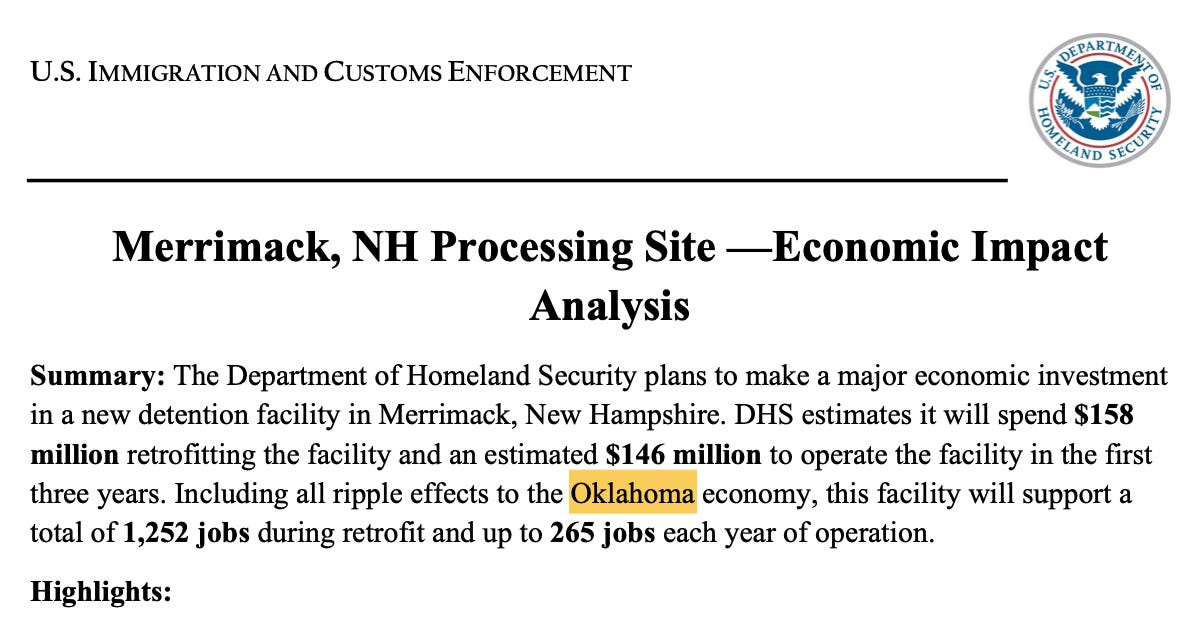
Governor Kelly Ayotte released a federal economic analysis on Feb. 12 that was supposed to justify a proposed ICE detention facility in Merrimack, N.H. Instead, state officials found a document undermined by references to economic benefits for Oklahoma, projections of millions in sales and income tax revenue from a state that has neither, and job figures inflated by counting theoretical grocery clerks and gas station attendants as positions “supported” by the project.
The flawed assessment is the latest misstep in the Trump administration’s rush to spend $38.3 billion on detention expansion. State Senator Tim McGough, a Republican who represents Merrimack, called it “clearly a cut-and-paste job.”
Ms. Ayotte released the documents after ICE Acting Director Todd Lyons told the Senate he had already shared the analysis with her — a claim she flatly denied.
The most obvious error appeared in the executive summary, which made an explicit reference to “ripple effects to the Oklahoma economy.” Oklahoma City had been on the original list of sites for ICE’s Detention Reengineering Initiative, but Mayor David Holt announced in late January the project was “off the table” following local opposition.
DHS later sent a corrected version, calling it “a single typo.” But the error suggested officials had recycled an Oklahoma assessment nonetheless.
'Including Sales Tax and Income Tax'
The assessment projected millions in sales tax and income tax revenue. New Hampshire has neither. The state’s “Live Free or Die” identity is built partly on a tax structure that relies on property taxes, business taxes and fees instead.
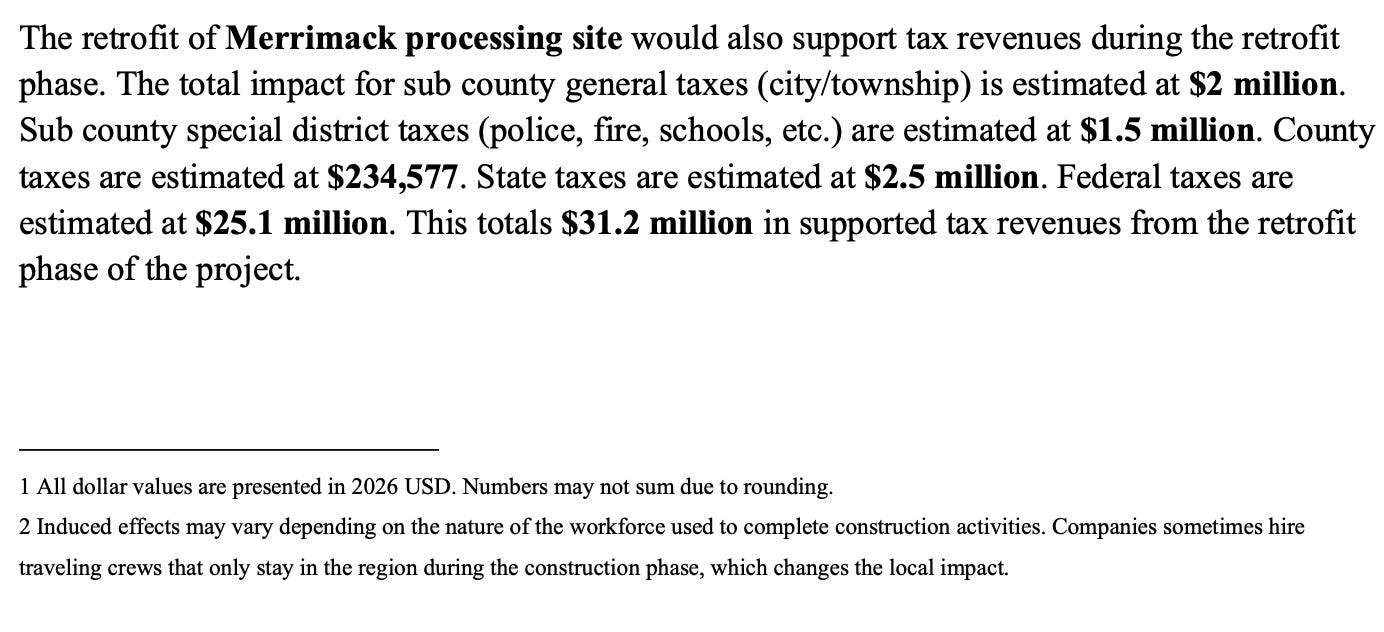
The document explicitly states that “approximately $10.7 million in local, state and federal tax revenue would be generated by annual operations, including sales tax and income tax.” The tax impact tables break down projected state tax revenue of $1 million and include line items for taxes New Hampshire doesn’t levy.
The warehouse at 50 Robert Milligan Parkway generated $281,765 in property tax revenue for Merrimack in 2025. As a federal facility, it would pay nothing. The analysis projected $410,123 annually in “sub county general taxes (city/township)” based on employee spending — but only if those 162 workers live locally and shop locally.
The agency claimed in the economic impact document that it used a “standard input-output (I-O) economic impact model” with “detailed data on New Hampshire’s economy, including industry linkages, wages and household spending patterns.”
But if the model used New Hampshire data, how did sales and income taxes — revenue streams that don’t exist in the state — end up in the final projections?
The timing of the phantom tax projections is particularly puzzling. On Feb. 4 — just 12 days before the Merrimack analysis was released — ICE made its first purchase of IMPLAN economic modeling software for $129,000. The procurement records describe it as “specialized software” that is “essential for accurately analyzing and quantifying economic impacts of ICE operations.” The purchase was marked as “urgent.”
IMPLAN is the industry standard for input-output economic modeling. Its entire purpose is to provide state-specific economic data — including accurate tax structures. Any competent use of the software would have immediately flagged that New Hampshire has no sales or income tax.
This raises three possibilities. Either ICE purchased the software but didn’t use it for the Merrimack analysis, suggesting the assessment predated the tool acquisition. ICE used the software but ignored its outputs. Or ICE used the software incorrectly, undermining claims of rigorous economic modeling.
The agency’s sudden acquisition of professional economic modeling software — after years of not producing such analyses — coincided precisely with the rollout of economic impact assessments for detention facilities. The Merrimack document and similar claims made in recent days about a warehouse purchase in Romulus, Mich., suggest ICE is attempting to reframe mass detention as economic development
The shift comes as ICE rushes to spend $38.3 billion and meet tight congressional deadlines. Whether the analyses are being conducted rigorously or adapted from templates remains unclear — and DHS has not provided the underlying data that would allow for independent verification.
A Footnote That Undermines the Headline
The headline figure — 1,252 jobs during retrofit, 265 during operations — masked what the document itself categorizes as “indirect” and “induced” employment.
For the construction phase, the assessment breaks down the total as “756 direct jobs” for workers actually at the construction site, “163 indirect” jobs and “333 induced” jobs.
For ongoing operations it predicted “162 direct jobs” at the facility, “five indirect” jobs and “98 induced” jobs.
The document acknowledges uncertainty about these induced figures, noting in a footnote that “induced effects may vary depending on the nature of the workforce used to complete construction activities. Companies sometimes hire traveling crews that only stay in the region during the construction phase, which changes the local impact.”
In other words, the 1,252 figure assumes construction workers will live locally and spend their wages in New Hampshire. The 756 figure assumes traveling construction crews. The true number depends on factors the analysis doesn’t address — yet the higher number became the headline claim.
The assessment provides no explanation of how ICE would recruit and retain 162 workers in a tight labor market, or whether those positions might simply draw employees from existing public safety agencies, creating staffing problems elsewhere.
$38.3 Billion in Six Months
Merrimack is one piece of the Trump administration’s Detention Reengineering Initiative, a plan to build capacity for more than 92,000 people by fiscal year end. The $38.3 billion initiative, funded through the One Big Beautiful Bill Act, represents a nearly 400 percent increase in ICE’s detention budget.
ICE has rapidly purchased at least seven warehouse properties in recent weeks. In Mississippi, Senator Roger Wicker, a Republican, successfully blocked a facility citing economic concerns mirroring New Hampshire’s. Nearly 90 percent of current ICE detainees are held in for-profit facilities — what the Brennan Center for Justice calls a “deportation-industrial complex.”
Conditions have deteriorated as ICE has rushed to expand. Six people died in ICE custody in the first two weeks of 2026 alone, according to the American Immigration Council. Medical care has been hampered by a payment freeze to medical contractors expected to last until late April 2026.
A Republican Governor Pushes Back
Ms. Ayotte’s public release of the documents came only after ICE Acting Director Todd Lyons testified before the Senate that he had already shared the analysis with her — a claim she flatly denied.
“This is simply not true,” Ms. Ayotte said. “Director Lyons’ comments today are another example of the troubling pattern of issues with this process.”
Massachusetts Gov. Maura Healey seized the moment to call on Ms. Ayotte to “do everything in her power to block” the facility. Ms. Ayotte, caught between supporting immigration enforcement and constituent concerns, has not said whether she will actively oppose the project.
Please keep sharing with Rachel Maddow! 👍She reported on this last night👏
Not a comment, but a THANK YOU for this work you’re doing.