

Internal ICE Documents Reveal $38 Billion Strategy to Expand Detention, Buy Warehouses, and Bypass State Laws
The agency has yet to secure key sites, and officials are still debating detainee stays.
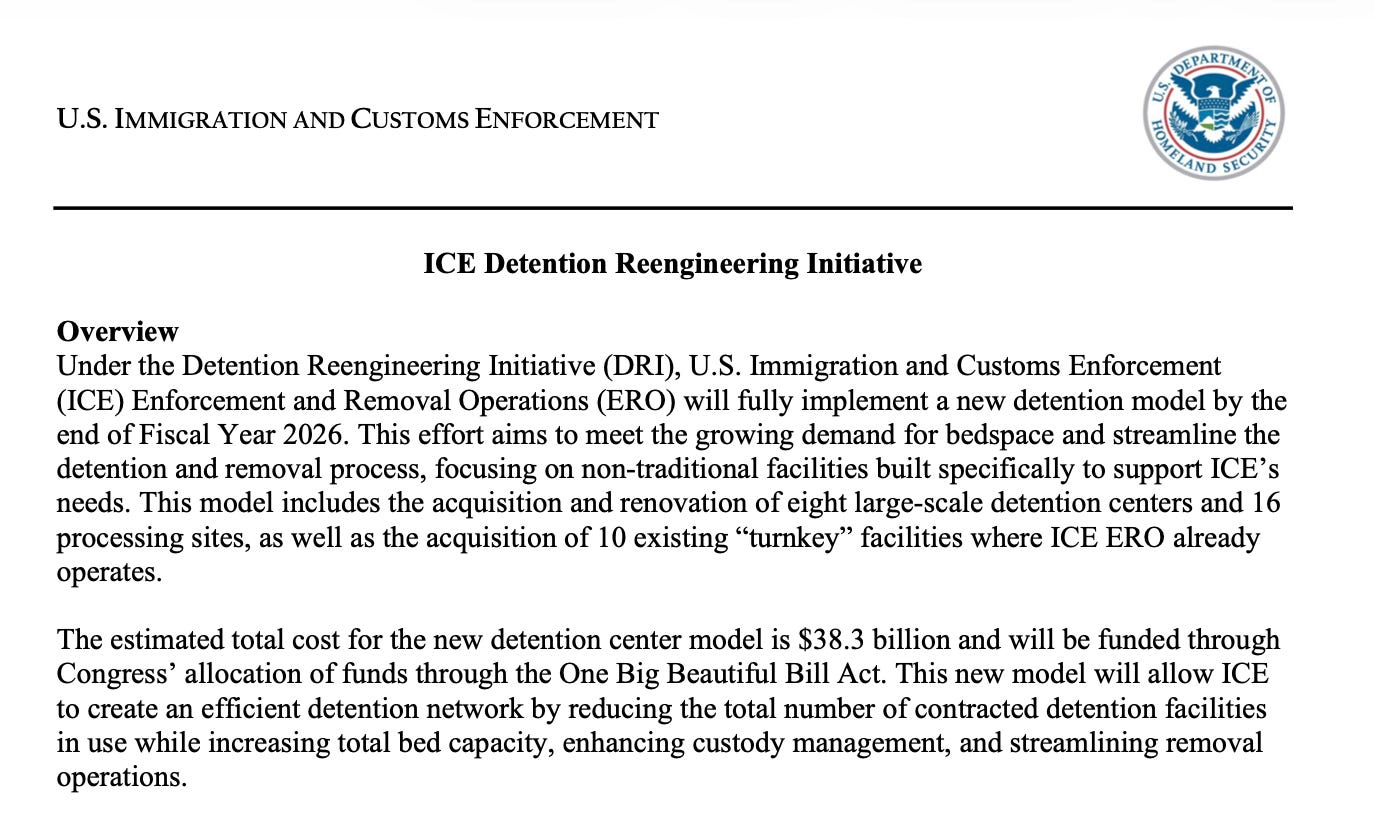
Governor Kelly Ayotte of New Hampshire on Thursday released internal federal documents outlining a sweeping $38.3 billion plan by U.S. Immigration and Customs Enforcement to overhaul the nation’s detention network, providing the first detailed public look at what the government calls the Detention Reengineering Initiative. The files were made public by Ayotte’s office and first reported by The Boston Globe after weeks of conflict over a proposed ICE facility in Merrimack, N.H. and pressure following testimony by the agency’s acting director before a Senate committee.

The initiative indicates that ICE’s detention infrastructure is expanding from renting bed space in local jails to owning and operating more facilities, including large “mega‑centers” and smaller “processing sites.” According to the documents, the government aims to implement this new model by the end of fiscal year 2026, adding as many as 92,600 beds to the federal detention system.
The Detention Reengineering Initiative paper outlines a detailed roadmap for this expansion. ICE would purchase 34 facilities outright, including eight large-scale centers and 16 regional processing hubs, using federal funds allocated through the “One Big Beautiful Bill Act.” The plan emphasizes federal ownership to circumvent state-level restrictions on contracting with ICE, and it includes engineering reviews to ensure the facilities can operate independently of local infrastructure, such as water, power, and wastewater systems.
Tracker Data Shows Gaps Between Plan and Progress
Based on our Project Salt Box warehouse tracker, which compiles nationwide property acquisitions and cancellations connected to the initiative, ICE has identified seven of its eight planned large‑scale centers; four have been purchased and three were canceled, leaving four additional centers needed to meet the original goal.
For the 16 regional processing sites the plan calls for, Project Salt Box has documented 11 — five purchased and four canceled, with at least six pending sites required to proceed and five more needed beyond those to meet the target.
Internal Questions Over Intended Use
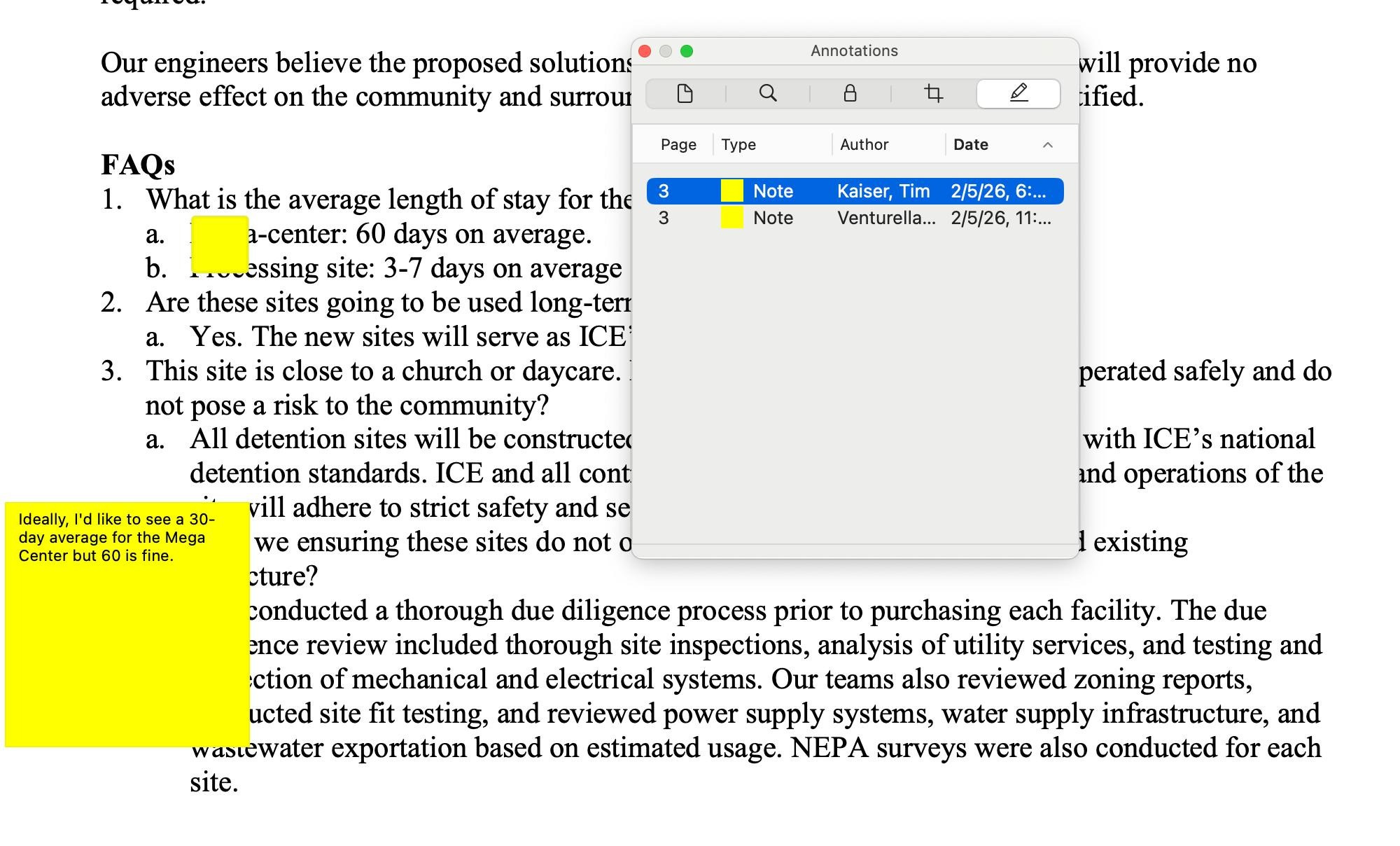
Metadata analysis of the documents released by Ayotte shows highlighted internal comments from Tim Kaiser, deputy chief of staff at U.S. Citizenship and Immigration Services, asking David Venturella, ICE’s senior official overseeing detention contracts, to confirm whether a 60‑day average stay at mega-centers was correct. Venturella responded, “Ideally, I’d like to see a 30‑day average for the Mega Center, but 60 is fine.”
It is unclear why the deputy chief of staff of USCIS, an agency primarily responsible for immigration benefits, was discussing detention centers with an ICE official.
The exchange, dated Feb. 5, 2026, indicates that DHS was still internally debating fundamental operational assumptions less than a week ago. How long detainees are expected to stay affects staffing, medical care, and facility capacity, highlighting that the agency’s ambitious plan may not yet be fully operationalized and is still being shaped by officials with deep ties to the private detention industry.
These are factors that ICE appears to be modeling using tools like IMPLAN. On Feb. 3, 2026, the agency purchased a 12‑month license for IMPLAN economic modeling software from IMPLAN Group LLC, citing it as “essential for accurately analyzing and quantifying economic impacts of ICE operations and activities.” The software could likely help ICE forecast the costs and infrastructure requirements of its mega-centers and processing sites, linking internal debates over detainee turnover to the agency’s broader economic and operational planning.
Former Private Prison Executive Shapes ICE Policy
Mr. Venturella’s role is itself controversial. According to reporting from The Washington Post, Venturella was previously a top executive with the private prison firm GEO Group, which oversees many ICE detention centers. He was granted a federal ethics waiver to serve as a senior adviser at ICE despite rules generally barring former contractors from participating in related decisions.
This “revolving door” between the federal government and private prison companies has drawn criticism from lawmakers and ethics experts, who argue it creates potential conflicts of interest and reinforces close ties between ICE and its largest contractors.
The Merrimack Flashpoint
The flashpoint for the controversy is a proposed processing site at a 324,000‑square‑foot warehouse at 50 Robert Milligan Parkway in Merrimack.
Local and state officials say they were not adequately informed about the proposal. Ayotte has denied that she was ever briefed by federal officials before last week’s Senate hearing, and she has ordered an investigation into why staff in her own administration were aware of communications between the Department of Homeland Security and state agencies before she was.
The newly released federal materials describe plans to retrofit warehouses into facilities housing thousands of detainees. But local opposition and cancellations — notably in states including Missouri, Utah and Oklahoma — have slowed the rollout. ICE now faces a tight deadline to have the sites operational by Nov. 30, 2026, and must still secure multiple large centers and processing sites to meet its stated goals.
As ICE moves forward with its nationwide detention overhaul, the gaps between projected capacity and facilities confirmed by tracking data, along with ongoing debates inside the agency and pressure from state and local officials, suggest the initiative will face legal, political and logistical challenges in the months ahead.
I find it interesting that November is the date they want these built by
Our government is not deporting these people. They are building a class of indentured servants. https://youtu.be/zdWrHb8b-c0?si=7NeqrE8p-uiUzu-4